Advice center
Older Walls in Punxsutawney Homes: A Plain Guide
If you live in an older house in Punxsutawney, there's a fair chance your walls aren't drywall at all. Census figures for 2020 to 2024 count 1,319 of the borough's 3,072 homes as older than 1940, 262 more from the 1940s and 447 from the 1950s. This guide walks through what those walls are made of, how they age, and why repairing them calls for other methods.
Start by working out what the wall is.
A few simple tests settle it, and none of them need tools. First, knock. Between studs, drywall gives a papery, drum-like knock and flexes slightly; solid plaster answers with a dull, hard thud, almost like rapping on stone. Then push a thumbtack into a hidden spot. It sinks into drywall easily and barely marks plaster.
Next, remove the plate from a light switch and look at the wall where it meets the electrical box. Drywall shows one layer, roughly a half inch, with paper on its front and back. Plaster on lath shows a thicker, gritty band, often nearer an inch, with wooden strips behind. Finally, glance at an outside corner. In the photo below, the finish has peeled back to show a metal edge strip, which is how plaster and drywall corners are both commonly made, so a corner alone won't answer the question.
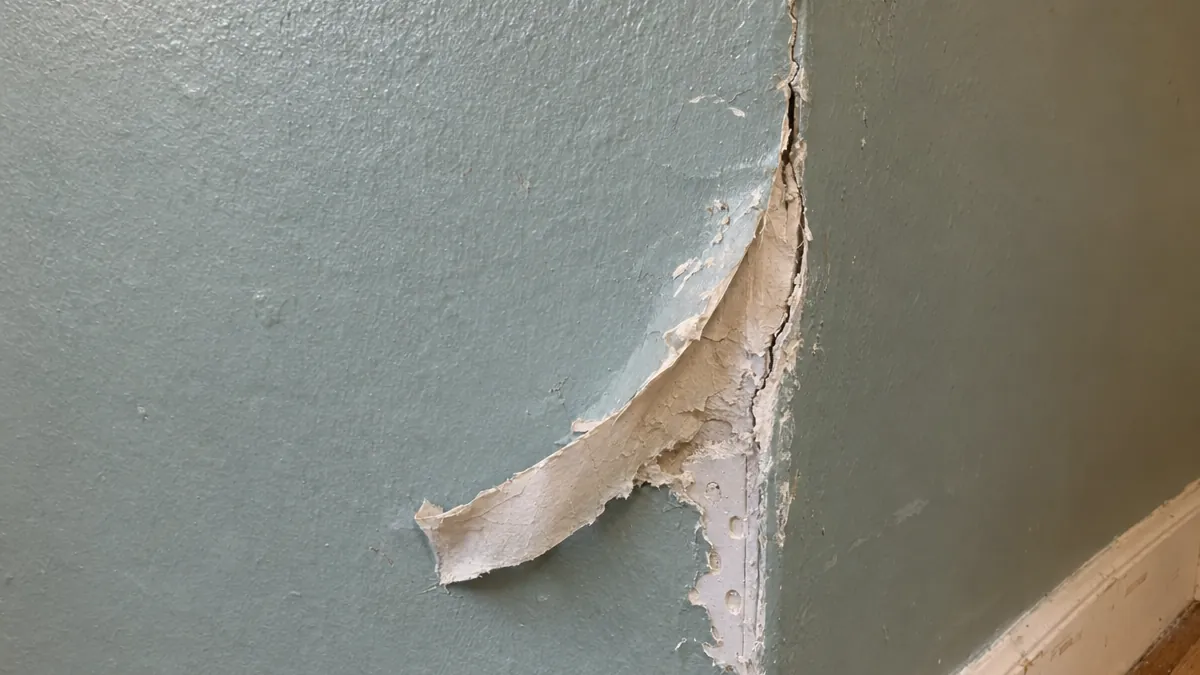
Plaster on wood lath came first.
Plaster on wood lath is the oldest of the three wall types in this guide. Narrow wooden strips were nailed sideways over the studs with slim gaps left open, and plaster went on in two or three coats: a coarse first coat squeezed through the gaps, a leveling coat, then a thin, hard finish coat. The first coat's keys, the blobs that curl behind each strip, hold the wall on.
These walls age in a predictable way. The house settles, and the studs and joists shrink and swell with the seasons. In Punxsutawney, nightly lows stay under 32 degrees for five months of the year, so a furnace runs a long time and dries the wood out. Over many winters the keys give way one by one, and plaster comes loose from its strips while still looking whole.
Plaster on masonry behaves differently.
In brick and stone buildings, plaster was often applied straight onto the masonry. There are no keys to break, but these walls carry a weakness of their own: moisture. Water from a leaky gutter or wet soil can travel through the masonry and push the plaster off from behind, leaving it soft, powdery or blistered. Putting that right starts outdoors, wherever the water is getting in.
The borough has both kinds of building. On West Mahoning Street, the National Register lists the Christian Miller House, a frame house from about 1870, just down the street from the T. M. Kurtz House, a brick house from 1904.
Early board looked like a shortcut.
Between full plaster and modern drywall came gypsum lath, sometimes called rock lath: smallish gypsum panels nailed up instead of wooden strips, then covered with coats of plaster. From inside the room it looks like plaster, because it is. But behind it sit panels with joints, and cracks in these walls often run in straight lines along those panel edges.
Drywall as we know it, large sheets taped at the joints with no plaster coat, came later and gradually took over from plaster. In a house from the 1950s, and the borough has 447 of them, either one is possible, and a peek behind a switch cover will tell you which.
Repairs change with the wall.
Repairing plaster isn't the same as patching drywall, and that's the most useful idea to take from this guide. A drywall repair can be cut, screwed in and taped with drying time spread over a day or two. Plaster usually needs one of three approaches: pinning loose plaster back with washers, rebuilding an opening layer by layer with hardening compound, or setting in drywall raised on shims until it meets the deeper plaster face.
Thickness is the detail people miss. Plaster walls are often well over half an inch deep, so a standard sheet dropped into an opening sits below the surface and leaves a dip. Texture is the other. Hand-troweled plaster has a soft, slightly uneven face that a sprayed drywall texture doesn't copy.
If your house is old and a wall is cracking, bulging or sounding hollow, the plaster and lath repair page goes into the methods more closely, and the crack page explains why some cracks return each winter.